Caravaggio Medusa - Uffizi Gallery Masterpiece Guide
Complete guide to Caravaggio’s Medusa at the Uffizi Gallery. Discover the painting’s mythological origins, dramatic style, and visiting tips.
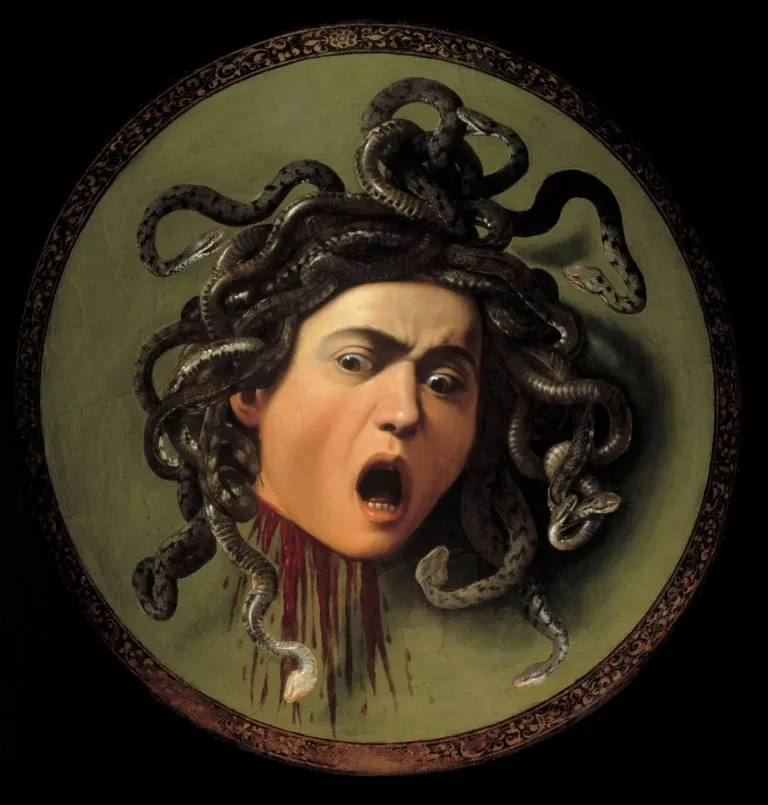
Medusa by Caravaggio: A Baroque Masterpiece of Terror and Beauty
Caravaggio’s Medusa (c. 1597) is one of the most striking images of the Baroque era. Painted on a convex wooden shield, it captures the precise instant of the Gorgon’s decapitation by Perseus. Housed in the Uffizi Gallery, this extraordinary work combines mythological storytelling with Caravaggio’s revolutionary realism and dramatic lighting.
The Story Behind the Painting
The painting was commissioned as a ceremonial gift for Cardinal Francesco Maria del Monte, Caravaggio’s patron, who then presented it to the Grand Duke of Tuscany, Ferdinando I de’ Medici. Its unusual support—a ceremonial shield—links the work to Medici court culture and Florentine collections of arms and curiosities.
Symbolism and Meaning
Caravaggio transforms the myth of Medusa into a theatrical moment of frozen horror, filled with layers of meaning:
Key Symbolic Elements:
- Medusa’s Head: Represents evil vanquished, but also the terrifying power of the gaze—viewers are confronted directly, as though they themselves risk petrification.
- Convex Shield: A reference to Perseus using a mirrored shield to defeat Medusa; its bulging surface makes the head seem to project outward, intensifying the illusion.
- Caravaggio’s Self-Portrait: Scholars believe the face of Medusa may partly mirror Caravaggio himself, inserting the artist into the myth and underscoring the theme of transformation.
- Blood and Snakes: Painted with startling realism, symbolizing both death and the writhing persistence of danger.
Technical Mastery
Caravaggio’s Medusa exemplifies his bold innovations:
- Chiaroscuro: Extreme contrasts of light and shadow heighten drama and three-dimensionality.
- Naturalism: Snakes, blood, and expression rendered with visceral realism.
- Illusionistic Space: The convex shield and foreshortened head project into the viewer’s space.
- Psychological Impact: Shock and immediacy replace traditional heroic distance.
Caravaggio and the Medici
The work’s journey from Caravaggio’s studio to the Medici court reveals the interconnected world of artists, patrons, and collectors at the turn of the 17th century. It stands at the crossroads of Roman Baroque innovation and Florentine display culture.
Visiting Tips
When viewing Medusa at the Uffizi:
- Best Viewing Time: Mornings offer calmer galleries.
- Room Location: Exhibited in the Caravaggio section of the Uffizi’s Gallery of Paintings.
- Notice the Surface: Look closely at the convex shield—the distortion is part of the illusion.
- Audio Guides / Tours: Helpful for understanding the myth and Caravaggio’s technique.
Cultural Impact
Caravaggio’s Medusa has inspired countless later images of horror, from film posters to fashion motifs. Its blend of myth, realism, and psychological tension makes it one of the most iconic depictions of Medusa in art history.
Conservation Efforts
The Uffizi has carefully conserved the shield to preserve its vivid greens, reds, and shadows. Restoration work has brought out details of the snakes and Caravaggio’s brushwork, ensuring the painting retains its visceral power for future visitors.
Encountering Caravaggio’s Medusa is like meeting the myth face to face—an unforgettable highlight of the Uffizi.
Over de auteur

Dr. Maria Rossi, Art Historian
Gepassioneerd door kunst en reizen, heb ik deze site gemaakt om medereizigers te helpen het meeste uit hun bezoek aan de Uffizi Galerij in Florence te halen. Met jarenlange ervaring in het verkennen van musea over de hele wereld, deel ik praktische tips en inzichten om uw culturele reis te verrijken.
Tags
Comments (0)
Loading comments...